

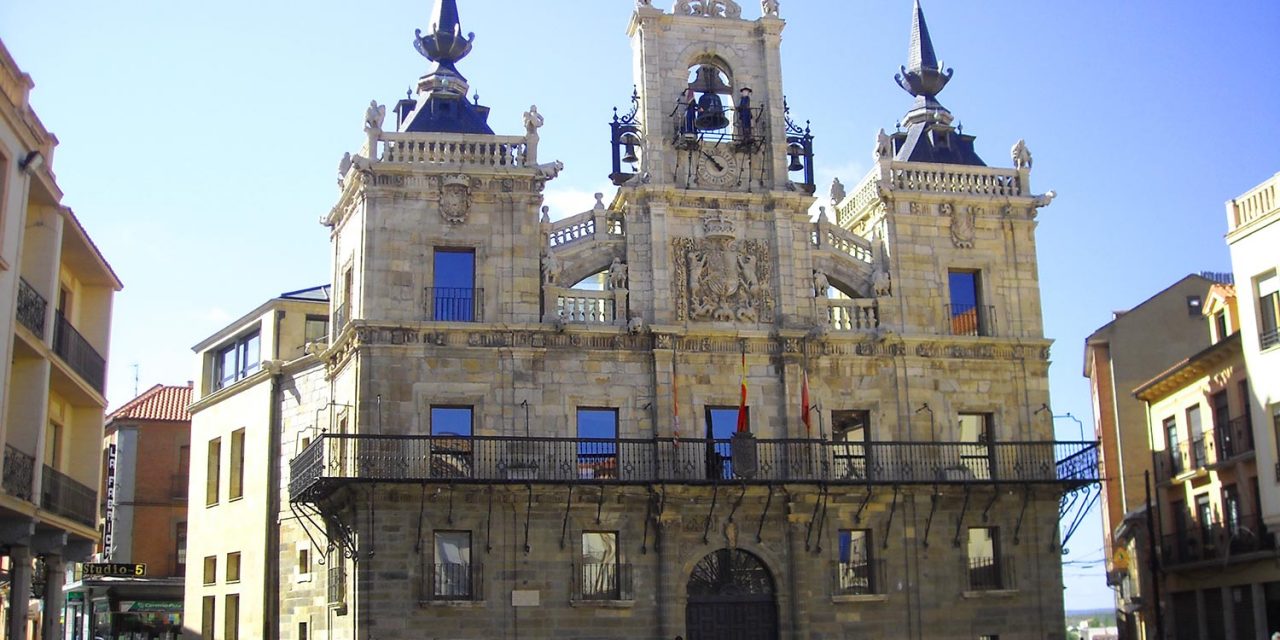
Presiding over the Plaza Mayor of Astorga, we see the Baroque building of the City Hall from the late 17th century. It was designed by the architect Manuel de Lastra, and its construction began in 1683 and was completed in 1703, although in later years some additional elements of the façade were completed.
Manuel de Lastra also worked on the construction of the main façade of the Cathedral of Astorga, so the City Hall building follows a structure very much in line with the cathedral’s façade, highlighting the use of the central bell-gable flanked by two lateral towers. This same layout, originating in the Cathedral of Astorga, was repeated in several town halls in the province of León, thus showing how this Baroque construction pattern developed for religious buildings was also adapted for civil buildings.
It has three construction levels in elevation: the first opens to the visitor through a semicircular arch, flanked by pilasters; in this level, the wall is enlivened by square-shaped openings. The second level opens through five openings, with the central one standing out. The iron balustrade that borders the balcony running along the entire façade is a later addition after the completion of the works. And finally, the top part of the building, added in the mid-18th century, features a large bell-gable topped with the royal coat of arms and flanked by two towers crowned with spires of clear Herrerian influence. The central structure is connected to the towers by flying buttresses. Decorating the towers are the coats of arms of the city and of the Marquises of Astorga; there are also sculptures topping the upper balustrades and gargoyles on the corners of the highest level of the towers. At the top of the bell-gable is the clock from the mid-18th century, made by the master clockmaker Bernardo Francos, and the bell that strikes the hours thanks to two automatons dressed in traditional Maragato clothing.
Inside, the most notable feature is the Plenary Hall, decorated with commemorative plaques of distinguished figures of the city such as Pío Gullón Iglesias, Manuel García Prieto, or Marcelo Macías y García, among others.
Curiosities:
The current building was restored by the architect Andrés Lozano in 1995. A complete renovation of the building was carried out, but its original façade was preserved due to its artistic and heritage value.
On the left tower, the coat of arms of the Marquisate of Astorga is missing. It was destroyed by order of the French military governor General Jean Baptiste Jeanin after the city was taken by Napoleon’s armies in 1810. This was due to the fact that the Marquis of Astorga had been president of the Central Supreme Junta, responsible for the defense and government of the country at that time.
The City Hall clock has had three mechanisms throughout its history: the original designed by Bernardo Francos in 1748, another later one commissioned to Bartolomé Fernández in 1804, and the most recent one, with a greater degree of automation, made by Hermenegildo Díguele and his son Ramón in the year 1974.
The automatons that ring the bell every hour are two Maragato figures named Juan Zacunda and Colasa. They are positioned one on each side of the bell and strike it alternately with a hammer. They have undergone modifications in parallel with those made to the clock. In the original clock, the automatons were two male figures made of wood. In 1804, they were changed to a man and a woman, and in 1974, the figures were replaced with the current polychrome aluminum ones.