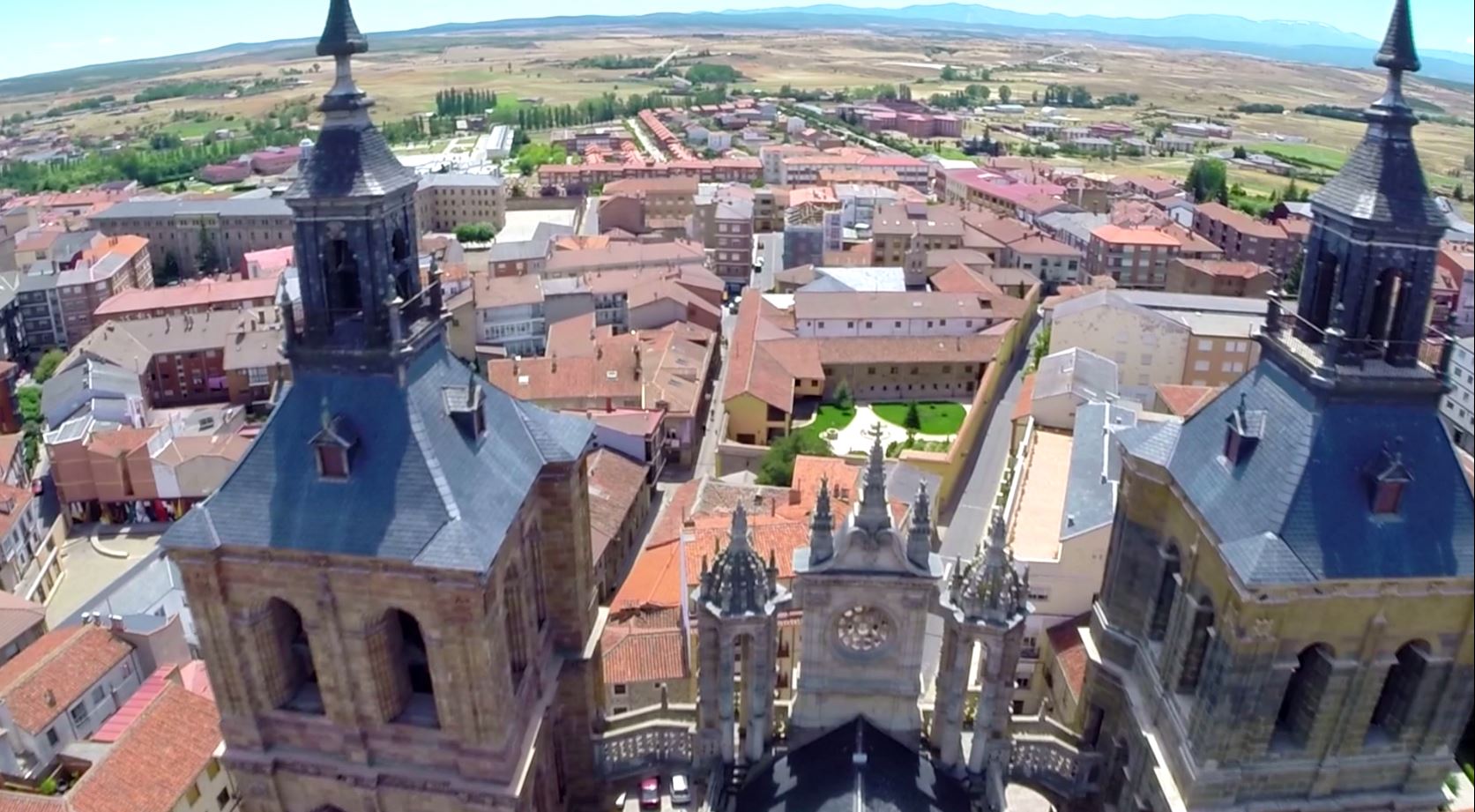


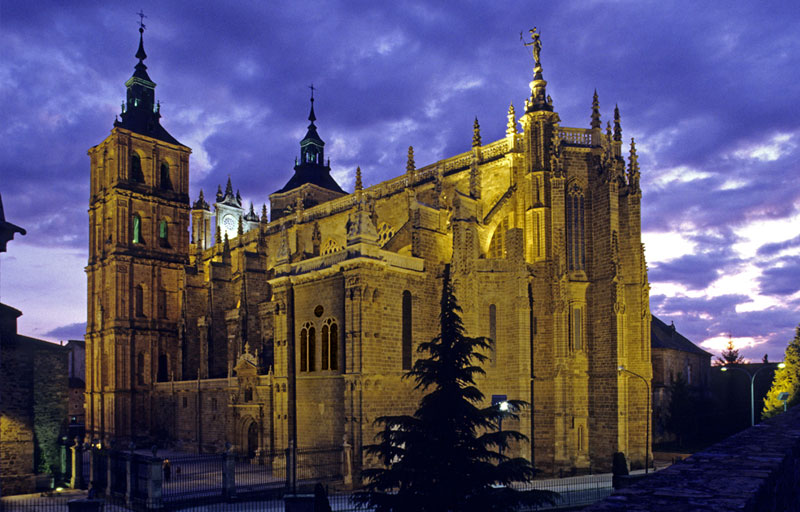
Without a doubt, anyone who approaches Astorga cannot fail to admire, from the outskirts of the city, the solemn view of the Cathedral of Saint Mary, with its towers and gable rising above the surrounding buildings.
In addition to the Cathedral, we find, attached to it, a rich architectural complex composed of the Cathedral Museum, the Diocesan Archive, and the Hospital of Saint John. The latter bears witness to the city’s strong Jacobean tradition, which throughout its history has had numerous hospitals dedicated to serving pilgrims on the Camino de Santiago. The Hospital of Saint John originated in the 12th century, although the current Neoclassical building was constructed in 1776.
The Cathedral offers visitors a great variety and wealth of architectural styles, as it combines several construction periods in one. Work began in 1471 by modernizing the structure of the previous Romanesque cathedral and adapting it to the new Gothic needs. For various reasons and historical twists, the works extended until the 18th century, hence the enormous stylistic richness we can admire during a visit to the Cathedral.
Its structure is basilical in plan with three naves and three polygonal apses with side chapels flanked by buttresses.
From its Gothic era, we highlight the work of two renowned artists: Juan de Colonia and his son Simón de Colonia. From their hands come the wonderful ribbed vaults with tiercerons and liernes in the central nave and side chapels. In the vault of the High Altar Chapel, the ribs and their central keystone are prominent, decorated with a polychrome boss adorned with eagles and angels bearing musical instruments.
From the Renaissance period, the work of Rodrigo Gil de Hontañón on the Portal of the Bishops stands out. While working on the project, he resided in the city of Astorga, as did other stonemasons such as Juan de Alvear and Juan de Alvarado.
What most surprises visitors is the majestic western façade in Baroque style. It opens to us through three recessed portals, flanked by two imposing towers topped with slate spires. The variegated style typical of the Baroque is most evident in the exceptional sculptural groups on the main doorway, as the ensemble resembles a large altarpiece where the iconography depicts biblical scenes such as Christ before the money changers in the Temple, the forgiveness of the adulterous woman, the healing of the paralytic, the healing of the blind man, and the outstanding central image of the Descent from the Cross.
Presiding over the central niche is the image of the Virgin of the Assumption, the dedication of the building; above her, Saint James the Apostle appears as a pilgrim in a triangular tympanum, welcoming and seeing off pilgrims passing through the city.
The large oculus at the center of the façade is decorated with stained glass depicting the Risen Christ. Above it are typical Baroque decorations with grotesques and mermaids, and a pierced rose window nestled between two hexagonal turrets topped with pinnacles.
Inside the cathedral, in addition to its majestic architecture, the High Altar is remarkable in Mannerist style. Created by Gaspar Becerra and polychromed by Gaspar de Hoyos and Gaspar de Palencia in the mid‑16th century, it was very innovative at the time, incorporating new Italian Renaissance influences, and served as a model for later altarpieces. The iconography depicts scenes from the lives of Christ and the Virgin Mary.
Other noteworthy altarpieces include that of the Virgin Majesty, featuring a 12th‑century statue with Byzantine influences; the Altar of the Immaculate Conception, whose titular image is the work of sculptor Gregorio Fernández from the 17th century; and the Altarpiece of Saint Michael, containing magnificent Hispano‑Flemish paintings, created in 1530.
Visitors can also admire the imposing choir stalls, made in the second quarter of the 16th century by various masters with clear Germanic and Central European influences.
The transept choir of the cathedral is Neoclassical in style and made of bronze, marble, jasper, and alabaster. Among other figures appears the image of Saint Toribius, patron of the Diocese.
The cathedral cloister dates from the Neoclassical period, specifically 1755, the work of Gaspar López. It consists of five arches on each side, joined by Ionic pilasters, and a well is preserved in its center.
Curiosities:
-
The Cathedral of Astorga is not oriented as is usual in the Christian world (to the east), but rather to the northeast.
-
The cathedral exhibits a wide variety of colors because the building’s construction lasted almost three hundred years, resulting in differences in stone age and provenance—hence the gray‑ish, green‑ish, brown, and orange tones seen in various parts.
-
One of the city’s most well‑known symbols is the figure of Pedro Mato, situated atop the apse. It is a figure dressed in regional costume holding a small standard. Restored in 1995, it has been dated to 1741; it is made of pine wood covered in lead. Originally painted, the original polychrome has not survived.
-
During the Napoleonic siege, French sappers dug a trench and a mine to blow up the wall near the apse. Legend says the soldiers shot the figure thinking it was a watchman signaling the city’s defenders; a piece fell and killed a French soldier, giving it the name “Pedro Mato”.
-
No one knows exactly whom “Pedro Mato” represents, but he is thought to be a wealthy Maragato who anonymously donated to complete the main portal; the figure was placed in gratitude wearing local Maragato costume.
Cathedral Museum
Planned by Bishop Grau Vallespinós in 1889, the museum was finally inaugurated on April 14, 1954. The museum premises formerly housed the Cathedral School, library, and archive.
Visitors can enjoy important and varied works of religious art, including:
-
The Crucified Christ by Gaspar Becerra, author of the cathedral’s high altarpiece, noted for technical quality and anatomical perfection.
-
A Romanesque head from the old cathedral, attributed to the master Mateo.
-
The famous Box of Saint Genadius, an exceptional 10th‑century Asturian pre‑Romanesque goldsmithing work.
-
The Romanesque trunk from Carrizo de la Ribera, a 13th‑century piece with well‑preserved polychrome.
-
A magnificent 10th‑century Fatimid Arabic censer set in silver.
-
The “Lignum Crucis” crafted in gold filigree and gemstones, containing a fragment of the True Cross brought from Jerusalem by Saint Toribius, bishop of the city.
-
Dalmatic and chasuble vestments, mitres, and other liturgical garments dating from the 12th to the 16th century.
-
Panels and various religious paintings from different periods, plus facsimiles of medieval codices and beatos.
Curiosity:
“Lignum Crucis” means “wood of the cross” in Latin and refers to fragments said to belong to Christ’s cross. Astorga’s Lignum Crucis was brought by Saint Toribius of Astorga, a 5th‑century cleric who traveled to Jerusalem. Named Sacristan Major of the Church of the Holy Sepulchre by Patriarch Juvenal, he was appointed Bishop of Astorga in 444. Returning to Spain, he brought several relics, including a fragment of the left arm of the True Cross—still the largest preserved today. The Lignum Crucis remained in Astorga until the 8th century, when it was transferred to the Monastery of Santo Toribio de Liébana due to wars under Alfonso I. Small fragments were left behind, which are embedded in the Lignum Crucis relic now displayed in the cathedral museum; the remainder is kept in Liébana.
One of the first signatures in the Cathedral Museum guestbook is that of Angelo Giuseppe Roncalli, today Saint John XXIII. He signed on July 24, 1954, when he was still Patriarch of Venice returning from a pilgrimage to Santiago de Compostela.