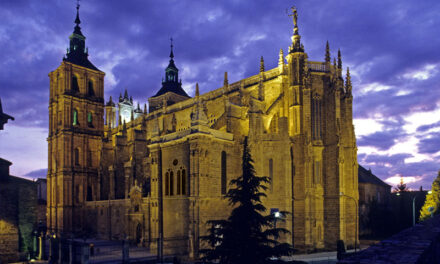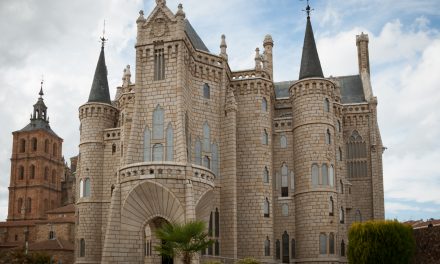


The church dates back to the 11th century but has undergone several renovations over the centuries. Nothing from the original period has survived, but parts from the 12th century remain, such as the offset tower. From the 14th century is the Gothic portal with two pointed arches and abacuses decorated with vegetal motifs; also Gothic in style are the rose window and the transept, which dates to the 16th century.
However, the church’s true beauty lies in its interior, where we find an abundance of plasterwork and are left in awe before its Main Altarpiece, in Churrigueresque style, presided over by the image of Saint Bartholomew, flanked by Saint Joseph, Saint John the Baptist, and a Crucified Christ. In the transept, there is an image of the Ecce Homo from the 17th century and of Our Lady of Sorrows, a sculpture created by the Valladolid sculptor José de Rozas in 1705, showing clear influences from similar works by the Renaissance sculptor Juan de Juni.
This church is the seat of two of Astorga’s Holy Week brotherhoods: the Brotherhood of the Knights of Silence of Our Father Jesus the Nazarene and the Archconfraternity of Our Lady of Sorrows.
The Brotherhood of the Knights of Silence of Our Father Jesus the Nazarene was founded in 1926. On the Saturday of Sorrows, it carries the image of the Ecce Homo in procession from the hermitage in the nearby town of Valdeviejas to the brotherhood’s meeting house next to the Church of San Bartolomé. It also participates in the Stations of the Cross Procession on Holy Tuesday along with other brotherhoods, and on Holy Thursday night it organizes the Procession of Silence, during which its titular image is carried.
The Archconfraternity of Our Lady of Sorrows was founded in 1911. During Astorga’s Holy Week, its main procession takes place on Palm Sunday afternoon, beginning and ending at the Church of San Bartolomé. The procession concludes with the entrance of the image of Our Lady of Sorrows, to whom the faithful sing a traditional popular Salve. The Archconfraternity also participates in the Stations of the Cross Procession on Holy Tuesday, alongside the other brotherhoods of the city.
Curiosities:
From the 14th to the 18th century, the City Council of Astorga met in the Church of San Bartolomé, as there was no public building designated for municipal government. The church hosted meetings of city authorities until the current Town Hall was built in the nearby Plaza Mayor between the late 17th and early 18th centuries.
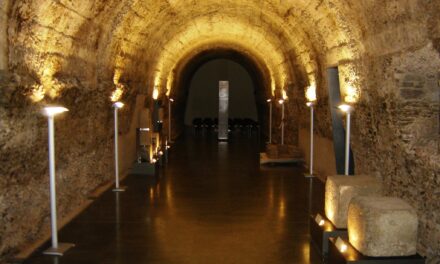
The Church of San Bartolomé stands on part of the land that once formed one end of the Roman basilica of Asturica Augusta. With the rise of Christianity in the empire, it became common for basilicas to transition from public Roman administration buildings to religious ones. So much so that one of the definitions of the word “basilica” in the Spanish Royal Academy Dictionary refers to it as: “a church notable for its antiquity or magnificence, or for the rites celebrated there, or one that enjoys certain privileges, in the likeness of Roman basilicas.”