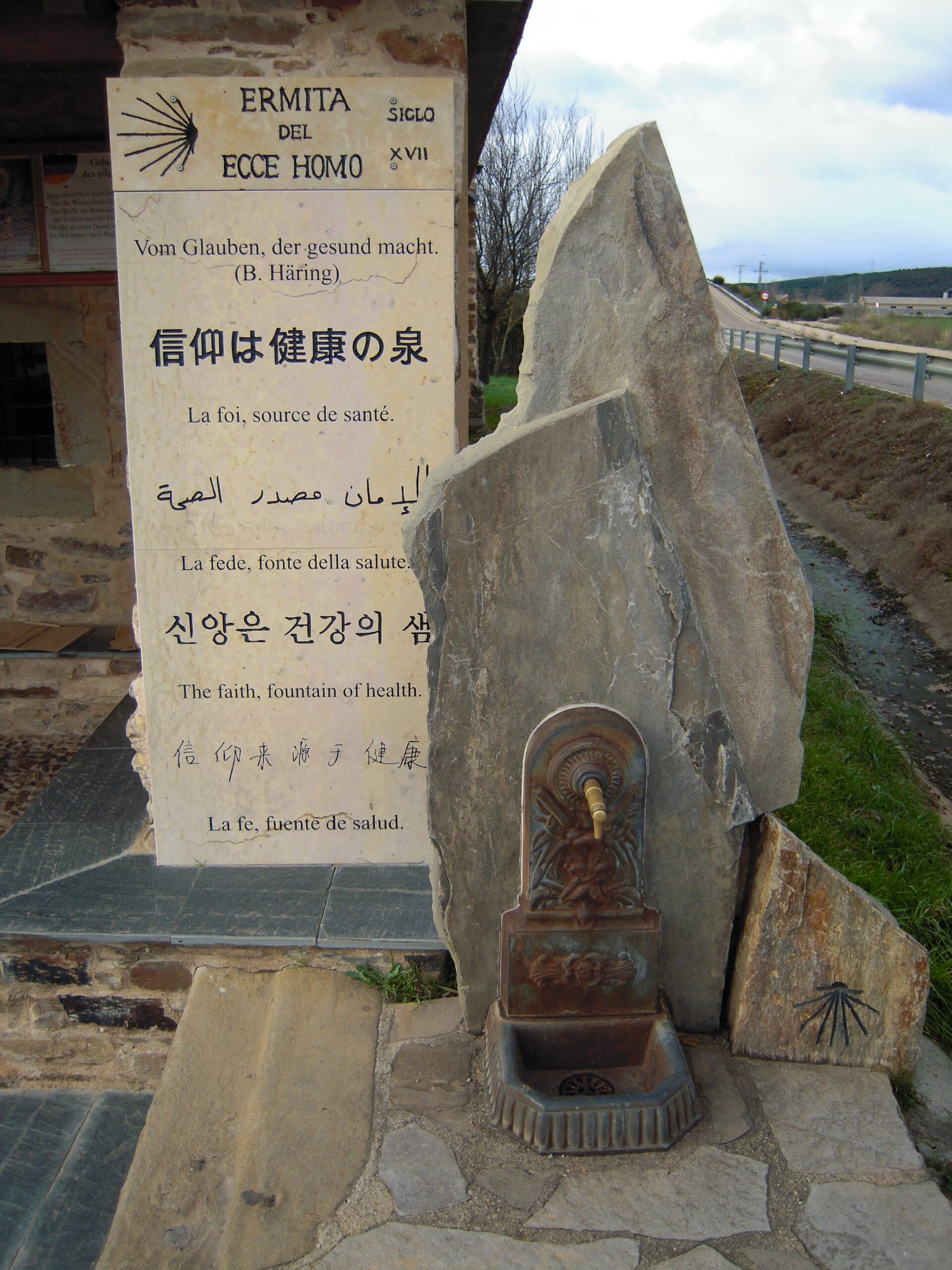


This hermitage was built in the 16th century. The building has a rectangular floor plan with a single nave; on the outside, it features a small bell-gable that holds a bell and a simple portico. Today, next to the hermitage there is a fountain that offers its waters to all the pilgrims who pass by. The presence of a well or fountain associated with a hermitage is a very common phenomenon along the Camino de Santiago.
Originally, it was dedicated to Saint Peter, but its dedication changed to the Ecce Homo due to a miraculous event that occurred in the well next to the chapel, where pilgrims used to stop to collect water. According to legend, a pilgrim woman and her son stopped to drink water at the well by the hermitage. By accident, the child fell to the bottom of the well. The mother, desperate and unable to go down to rescue him, prayed to the Ecce Homo to save her son. Immediately, a large amount of water began to gush from the well, causing the water level to rise until it overflowed, allowing the mother to rescue her son safe and sound, so they could continue their pilgrimage together to Santiago.
On the first Sunday in May, the residents of Valdeviejas take the image of the Ecce Homo in a procession to the parish church. The image is accompanied by traditional flute and drum music and by pendones (large ceremonial banners that are carried during major festivities). After the floral offering by the Brotherhood of the Knights of Silence of Our Father Jesus the Nazarene, the procession continues alongside the image of the Pilgrim Virgin to proceed with the blessing of the fields, especially those that produce the renowned “Pico de Pardal” chickpeas, a local variety grown in the area and a key ingredient in the region’s star dish, the famous Maragato Stew (Cocido Maragato).
On the evening of Passion Saturday, the image of the Ecce Homo is brought in procession from the hermitage to the headquarters of the Brotherhood of the Knights of Silence of Our Father Jesus the Nazarene, located next to the Church of San Bartolomé, where it remains on display until Holy Thursday. On that day, the image is carried in the Procession of Silence, organized by the same brotherhood.
Curiosities
Ecce Homo is a Latin expression meaning “this is the man” or “behold the man.” It is the phrase spoken by Pontius Pilate when presenting Jesus of Nazareth to the crowd in Jerusalem to decide his fate as a prisoner, according to the Vulgate, the Latin translation of the Bible made by Saint Jerome.
“To be like an Ecce Homo” is an expression used to refer to someone who appears seriously injured or in a poor physical state.
An inscription in the hermitage recalls the miraculous event that saved the pilgrim child, and it encourages pilgrims to leave a donation to avoid any danger or difficulty. The inscription reads:
“Traveler, give alms to this holy Ecce Homo and you will instantly see how you escape from your troubles.”
The current image of the Ecce Homo dates from the 19th century, as the previous one was destroyed during the Peninsular War. In 2016, the tradition of bringing this image in procession for the Holy Thursday Procession of Silence in Astorga was revived.